
Costs
Understanding ecommerce social media properly
ecommerce social media: platforms, shopping tools, FTC disclosures, accessibility, and retention tactics tied to accurate product data.
What to take away
- Start with a customer decision and a commerce-ready product, not a posting quota.
- Keep creative, tags, catalogs, price, stock, terms, checkout, and support aligned.
- Disclose commercial relationships where people can notice and understand them.
- Measure retained commercial value and customer health beyond platform engagement.
Ecommerce social media is the coordinated use of social platforms to help people discover, evaluate, buy, use, and discuss products. It can include organic posts, short video, live demonstrations, creators, community replies, paid distribution, product tags, platform shops, and customer service. The social channel does not remove ordinary duties attached to advertising and commerce.
A dependable program begins with the offer and operating model. The team must know who sells the item, who controls its price and inventory, where checkout occurs, who fulfills the order, how returns work, which party supports the customer, and how a creator or platform is compensated. Creative should never outrun those facts.
Choose a precise customer job
A post should do more than attract attention: it may demonstrate a product, explain fit, compare materials, answer an objection, or show use in context. It can announce a real offer, resolve a common problem, or route customers to support. Pick one primary job so message, evidence, format, destination, and measure stay coherent.
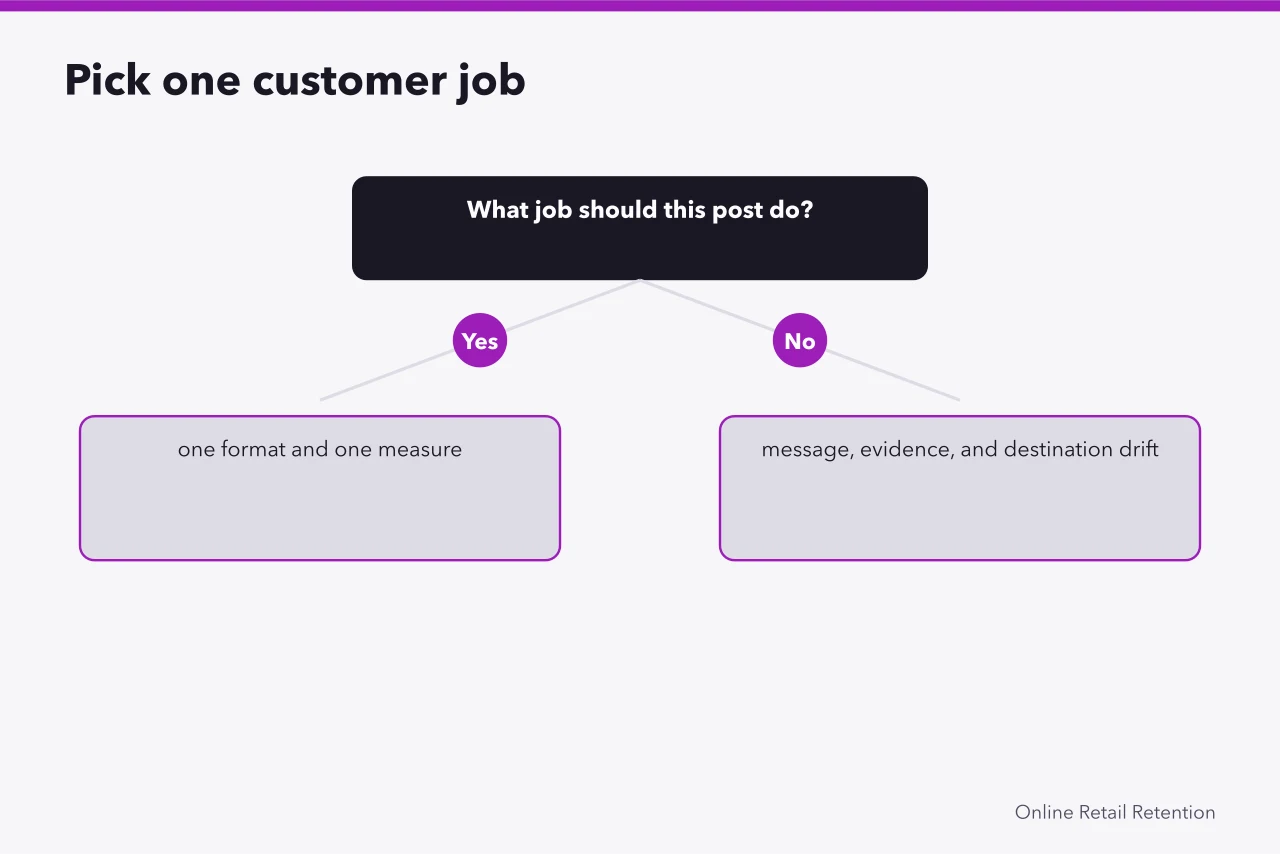
That single job shapes the ecommerce content marketing plan. Product truth and distribution must match the format.
Useful social format
- See the product in context
- Short demonstration
- Compare options
- Carousel or live comparison
- Confirm fit
- Q&A or decision clip
- Learn setup
- Captioned tutorial
- Evaluate an offer
- Terms-led post
- Resolve concern
- Public answer plus private route
Commerce next step
- See the product in context
- Current product detail
- Compare options
- Comparable eligible items
- Confirm fit
- Size or compatibility tool
- Learn setup
- Instructions or support
- Evaluate an offer
- Qualified landing or shop item
- Resolve concern
- Service or policy page
Define platform and merchant roles
Write a responsibility map for every program. Name the seller of record, account owner, catalog owner, advertiser, creator, agency, platform, payment handler, fulfillment party, service team, and finance owner. Document who approves claims, tags, discounts, comments, refunds, access, data transfers, and incident response.
Platform eligibility and interface features can change by country, account, category, device, and date. Record the official source, review date, account evidence, requirements, and fallback. Do not promise in-app checkout, tagging, or live shopping based on a screenshot from another market.
Named channels and commerce features give the plan something concrete to verify: Instagram Shops and Facebook Shops; TikTok Shop; Pinterest Product Pins; and YouTube Shopping. Retailers may also use Instagram, TikTok, Facebook, YouTube, Pinterest, X, Snapchat, and LinkedIn for distribution and conversation. These features are not interchangeable, and availability, checkout paths, and eligibility vary by market, account, category, and date.
For product data, retailers may encounter Meta Commerce Manager, TikTok Catalog Manager, and Google Merchant Center. Shopify and WooCommerce can be underlying store and catalog systems that supply data through supported integrations; validate the mapping and feed rather than assuming a connection guarantees approval or synchronization.
Make commercial relationships visible
The Federal Trade Commission's Disclosures 101 for social media influencers explains that a material relationship with a brand should be disclosed and that the disclosure should be hard to miss, understandable, and placed with the endorsement. It discusses pictures, videos, live streams, platform tools, and responsibility. Apply current law and qualified advice to the actual market and arrangement.
The applicable federal framework also includes the Federal Trade Commission Act and the FTC's Guides Concerning the Use of Endorsements and Testimonials in Advertising, commonly called the Endorsement Guides.
Create a disclosure rule for employees, affiliates, gifted products, discounts, paid creators, agencies, and platform incentives. Give contributors approved plain language and examples for each format. Review the final post where the audience will encounter it, not only the contract or content-management screen.
Use direct wording that accurately names the relationship, such as “Ad” or “Paid partnership with [Brand]” for paid work, or “I received this product free from [Brand]” for a gift. Put the disclosure with the endorsement; for video, make it clear within the video so viewers do not have to open a caption or description. A platform label can help, but do not assume it is sufficient by itself.
Build one source of product truth
Social creative can be produced days before publication while price, stock, eligibility, or offer terms change. Define the authoritative source for product name, variant, identifier, price, discount, inventory, shipping, safety, warranty, return policy, and destination. Attach a freshness rule to every volatile field.
Product truth preflight
- Product and variant match creative, tag, destination
- Price and promotion dates, exclusions, market match
- Availability eligible stock and fallback confirmed
- Claims evidence and limits recorded
- Delivery and returns terms current and reachable
- Catalog item feed status and diagnostics pass
| Field | Owner | Preflight |
|---|---|---|
| Product and variant | Merchandising | Creative, tag, and destination match |
| Price and promotion | Commercial owner | Dates, exclusions, and market match |
| Availability | Inventory owner | Eligible stock and fallback confirmed |
| Claims | Product and review owner | Evidence and limits recorded |
| Delivery and returns | Operations | Terms are current and reachable |
| Catalog item | Commerce operations | Feed status and diagnostics pass |
Do not publish a demonstration using one model and tag a similar model merely because it is available. Do not claim a color, feature, ingredient, compatibility, or outcome that appears only in the caption but not the product record. Stop or relabel the asset when the product changes.
Design creative that earns attention
Begin with the decision, not a generic trend. Show the relevant product clearly, identify the conditions, demonstrate the meaningful step, and state limitations. Use natural speech and specific visual evidence. A strong hook can be an honest problem, comparison, result boundary, or surprising product detail without manufactured urgency.
- Show scale, texture, motion, fit, or process when it affects selection
- Use captions and on-screen text that remain readable on a small screen
- Provide accurate alternative text where the platform supports it
- Avoid rapid or ambiguous edits that change the apparent product result
- Keep important terms visible long enough to understand
- Preserve original files, approvals, source facts, and permitted-use records
Use the W3C Web Content Accessibility Guidelines (WCAG) as a creative review reference: caption meaningful speech, maintain readable contrast and text, provide text alternatives where supported, and do not rely on color alone to convey product options. Check the rendered asset on mobile because platform controls differ.
Create variations because platform placements and audience contexts differ, not to flood every feed with the same asset. A six-second product reminder, a two-minute demonstration, a live Q&A, and a service reply owe different material. Maintain the core claim and product facts across each version.
Operate product tags and catalogs
A product tag is a promise that the visible item and selected destination correspond. Validate tag-to-product identity, variant, country, currency, availability, price, image, seller, shipping, and return information. Sample tags after publication because feeds, moderation, catalog updates, and product retirement can change behavior.
Validate product tags
- Tag-to-product identity and variant
- Country, currency, availability, price
- Image, seller, shipping, return information
- Sample tags after publication
- Pause distribution when offer misrepresented
Maintain a catalog incident queue for rejected items, stale prices, missing images, duplicate products, disapproved categories, broken destinations, and synchronization delays. Set severity by customer harm and commercial reach. Pause distribution when the tag or checkout path materially misrepresents the offer.
For example, an item rejection in Meta Commerce Manager or TikTok Catalog Manager can make a product unavailable for shopping features; a stale price or wrong variant can send customers to an offer that does not match the creative. A suspended commerce feature can break the in-app route, while lost account access can prevent timely catalog fixes. Record the customer impact and the fallback destination for each incident.
Manage creators as an evidence workflow
Select creators by audience fit, format skill, product credibility, disclosure behavior, brand-safety history, accessibility practice, commercial terms, and operational reliability. Audience size alone does not prove relevant reach or trustworthy influence. Verify claimed metrics and the person who will actually create the work.
The brief should state the product and variant, audience job, required factual points, prohibited claims, demonstration conditions, disclosure wording, destinations, permitted edits, review stages, usage rights, exclusivity, compensation, comment duties, schedule, records, correction, and removal. Leave room for the creator's real voice without surrendering factual control.
Prepare community and service response
Comments can reveal product questions, confusion, defects, safety concerns, spam, harassment, or service cases. Build a response matrix with public answer, private escalation, evidence requirement, response window, privacy boundary, and closure. Do not request order numbers, health details, or payment data in a public thread.
Comment response matrix
Comment type
- Product fact
- Answer from record
- Order issue
- Give secure route
- Safety concern
- Do not diagnose
- Complaint
- Address substance
- Harassment
- Apply moderation rule
- Counterfeit
- Avoid accusation
Public response
- Product fact
- Escalate uncertainty
- Order issue
- Verify identity
- Safety concern
- Specialist path
- Complaint
- Record and investigate
- Harassment
- Protect staff
- Counterfeit
- Preserve evidence
Private action
- Product fact
- Order issue
- Safety concern
- Complaint
- Harassment
- Counterfeit
| Comment type | Public response | Private action |
|---|---|---|
| Product fact | Answer from approved record | Escalate uncertainty |
| Order issue | Acknowledge and give secure route | Verify identity and case |
| Safety concern | Do not diagnose publicly | Use approved specialist path |
| Complaint | Address substance without argument | Record and investigate |
| Harassment | Apply published moderation rule | Protect staff and user |
| Possible counterfeit | Avoid unsupported accusation | Preserve and route evidence |
Plan paid amplification carefully
Organic response can suggest a useful asset, but it does not automatically identify a profitable audience or paid placement. Create a paid hypothesis with audience, creative, offer, destination, bid or budget rule, conversion definition, exclusion, frequency, brand-safety control, and stop condition.
Coordinate exclusions across prospecting, remarketing, customers, returns, complaints, and recent purchasers. A person who just bought the product may need setup help rather than another acquisition ad. A customer with an unresolved case may need promotions suppressed until service recovers the relationship.
Connect social to retention programs
Treat social as one entry point to retention, not a substitute for permission-based customer communication. Useful programs include post-purchase email or SMS for setup and care, replenishment or compatible-product messages when relevant, loyalty rewards, customer-created content and community participation, win-back campaigns for lapsed customers, and subscriptions when recurring delivery suits the product. Respect the customer’s choices and make it easy to get service rather than another promotion.
Measure the complete commerce path
Platform views, watch time, reactions, saves, and clicks describe observed journey parts, as do product views and attributed purchases. Alone, they do not show incremental demand, settled revenue, contribution, customer quality, or future delivery health. Reconcile social reports with commerce, finance, return, and service records.
Measure the commerce path
- Exposure: qualified reach and frequency
- Attention: view and completion behavior
- Action: clicks, product opens, shop activity
- Order: accepted and paid purchases
- Value: return-adjusted contribution
- Customer: complaints, support, repeat behavior
Those observed metrics feed the ecommerce marketing strategy, connecting channel results to store operations and economics.
| Layer | Measure | Limit |
|---|---|---|
| Exposure | Qualified reach and frequency | Platform estimation applies |
| Attention | View and completion behavior | Definitions vary by placement |
| Action | Clicks, product opens, shop activity | Identity and tracking gaps remain |
| Order | Accepted and paid purchases | Cancellation can follow |
| Value | Return-adjusted contribution | Costs and returns mature later |
| Customer | Complaints, support, repeat behavior | Other channels contribute |
Define every measure pre-launch, show raw counts beside rates, and use matched tests or holdouts when the business decision requires causal evidence. Keep platform attribution as one lens, not the accounting ledger.
Document organic labor, creator fees, product samples, commissions, and media; apply same discipline to ecommerce email marketing, where permission, useful messages, and deliverability decide whether a send helps or annoys. Document platform charges, returns, service cost.
Protect accounts and continuity
The business should retain administrative ownership, recovery, billing, verified domains, catalogs, pixels or tags, audiences, creative files, rights records, and exports. Give employees, creators, agencies, and tools the least access required. Review permissions routinely and revoke them promptly at the end of work.
Prepare for compromised accounts, impersonation, removed posts, catalog failures, suspended commerce features, creator disputes, viral criticism, product recalls, and platform outages. Name the decision owner, evidence to preserve, response channel, customer remedy, and fallback destination.
Run a weekly operating review
- Check scheduled creative against current products, offers, stock, and policies
- Review catalog and tag diagnostics
- Inspect disclosures and creator approvals in final placements
- Triage comments, service cases, safety reports, and impersonation
- Reconcile spend, orders, cancellations, returns, contribution, and invoices
- Record continue, correct, test, limit, pause, or retire with an owner
Ecommerce social media creates durable value when creative and commerce operate as one accountable system. The advantage is not being present on every platform. It is showing the right product truth to a relevant person, supporting an honest decision, fulfilling the promise, and learning from the complete result.
Check related email, SMS, and privacy obligations
The CAN-SPAM Act applies to commercial email, including marketing messages in retention flows. Review sender and subject accuracy, required sender identification, a functioning opt-out, and suppression of opted-out recipients. A social follow is not itself permission to send marketing email.
For SMS retention campaigns, assess the Telephone Consumer Protection Act (TCPA) and applicable state requirements for consent, messaging, and opt-outs. Obligations depend on the message and how it is sent, so do not treat a social follow or purchase as automatic authorization for every text campaign.
Before using pixels, uploading customer lists, or matching audiences, assess whether the California Consumer Privacy Act (CCPA), as amended by the California Privacy Rights Act (CPRA), and other state privacy laws apply. Map the data, notices, customer choices, and vendor roles required for the actual use.
Before release, record the tested data, responsible roles, product versions, exceptions, and approval date. Recheck after a material change to the source, model, access, contract, or decision, and preserve evidence of the review.
Common questions
What is ecommerce social media?
It is the coordinated use of social content, conversation, distribution, and platform commerce to support customer decisions and accountable commercial outcomes.
Which platform should a store use?
Choose by customer job and verify the actual account and checkout path. Consider Instagram Shops or Facebook Shops for eligible Meta shop surfaces, TikTok Shop for eligible TikTok shopping, Pinterest Product Pins for visual discovery, and YouTube Shopping for video-led product consideration. Instagram, TikTok, Facebook, YouTube, Pinterest, X, Snapchat, and LinkedIn can support different distribution or conversation needs; do not assume they offer the same commerce features.
Do product tags guarantee sales?
No. They can shorten a path, but product relevance, creative truth, price, availability, checkout, delivery, returns, and demand still matter.
Who owns the program?
A named business owner should coordinate product, creative, creators, commerce operations, media, service, finance, legal review, security, and platform access.
In this guide
- Common ecommerce social media questions: creators, reviews, shop dutiesCommon ecommerce social media questions answered: creator disclosures, the FTC reviews rule, fake followers, and the duties a store keeps on TikTok Shop, YouTube Shopping and other social shops.
- How to improve ecommerce social media: product pathHow to improve ecommerce social media: trace a tagged product from its catalog record to the live page, variant, and checkout before changing creative.
- Ecommerce social media examples: six brand accounts and the work behind each postSix real ecommerce brand accounts, from Glossier to Duolingo, and the product data, usage rights, disclosure and service work each post depends on.
- Ecommerce social media mistakes beyond the obvious: the 2027 viewCatalog defects, false reviews and hidden creator deals are the social media mistakes that spread furthest, because every channel reuses the same wrong record.
- Ecommerce social media checklist for release gatesThis ecommerce social media checklist covers release checks for disclosures, product paths, accessibility, catalog data, returns, and evidence.
- Ecommerce social media benchmarks: definitions, layers, and guardrailsEcommerce social media benchmarks explained through dated platform definitions, five measurement layers, catalog checks, and reproducible comparisons.
- How to test ecommerce social media toolsA practical trial framework for ecommerce social media tools, covering commerce jobs, catalog failures, approvals, data access, operating burden, and exit.
- Ecommerce social media best practices: 12 controlsEcommerce social media best practices: check product match, disclosure, accessibility, catalog health, offers, destinations, service and account access.
- Ecommerce social media agencies: commerce depth evidence to requestA look at ecommerce social media agencies, the commerce depth evidence to ask for, how to check claims and reviews, and what merchants should own before signing.
- How to evaluate ecommerce social media trendsA practical framework for evaluating ecommerce social media trends: test live and catalog features, govern creative, and track outcomes before wider adoption.