
Guides
Ecommerce analytics: from events to defensible decisions
Ecommerce analytics that holds up: define the commercial objects, write the event contract, reconcile to orders, and end in a decision someone owns.
What to take away
- Name the decision before you open a dashboard. A report with no decision attached is a hobby.
- Write down what cart, transaction, shipment, return and refund mean in your store. Two teams can otherwise report different revenue from the same orders.
- Reconcile events against orders, payments, returns and the finance ledger before a number reaches a budget meeting.
- Give every recurring report an owner, a refresh time and a last complete date.
- Put dated privacy obligations on the same map as your tags and reports, not in a separate legal folder.
- Publish what the report cannot seeconsent gaps, identity loss, immature return windows.
A dashboard is one view of a system. In ecommerce analytics, the system is the thing worth building.
Write the commercial objects down
Before any metric, define the words your store already uses loosely. A cart is not an order. An order is not a shipment. A refund is not a return.
Commercial Objects and Their Errors
Object
- Cart
- Session state
- Transaction
- Payment ledger
- Order
- Commerce order system
- Shipment
- Fulfilment records
- Return
- Return authorisation
- Refund
- Payment ledger
- Promotion
- Campaign rules
Authoritative record
- Cart
- Treated as intent
- Transaction
- Authorisation as settled
- Order
- Cancellations left in
- Shipment
- Label as delivered
- Return
- Refund before goods
- Refund
- Store credit as cash
- Promotion
- Discounted vs full-price
Error it causes
- Cart
- Transaction
- Order
- Shipment
- Return
- Refund
- Promotion
| Object | Authoritative record | Error it causes |
|---|---|---|
| Cart | Session or account state | Treated as intent to buy |
| Transaction | Payment processor or ledger | Authorisation counted as settled cash |
| Order | Commerce order system | Cancellations and fraud left in |
| Shipment | Fulfilment and carrier records | Label printed counted as delivered |
| Return | Return authorisation record | Refund issued before goods arrive |
| Refund | Payment ledger | Store credit counted as cash back |
| Promotion | Campaign and price rules | Discounted orders compared to full-price ones |
Then define the states each object passes through:
- attempted
- accepted
- failed
- cancelled
- reversed
- fulfilled
- retained A store that skips this step will argue about revenue every quarter and never settle it.
The event contract is the unit of trust
Every event needs a written contract before it ships. Record the business purpose, the owner, the trigger, and the entity it describes.
The tools hold different versions of the truth. Collection and product analytics platforms such as GA4, Adobe Analytics, Amplitude and Shopify Analytics describe sessions and events. Warehouses such as BigQuery and Snowflake, transform layers such as dbt, event pipelines such as Snowplow and Segment, and BI tools such as Looker each keep their own copy. Server-side tagging moves where that copy is made; a data clean room changes who may see it. None of them is the commercial record, and none of them reconciles itself.
Event Contract Checklist
- Business purpose, owner, trigger, entity
- Required fields, allowed values, timestamp rule
- Identity rule, consent behaviour, deduplication key
- Source, destination, retention period, version
- Negative statesinvalid coupon, no inventory
- Payment decline, duplicate order, cancelled shipment
- Failed delivery, completed refund
Include the negative states. Several order issues can occur:
- Invalid coupon
- No inventory
- Payment decline
- Duplicate order
- Cancelled shipment
- Failed delivery
- Completed refund Events that only fire on success describe a store that never has problems, which is not the store you run.
- Use stable names tied to commercial states, not to page layouts.
- Keep free text and unnecessary identifiers out of analytics fields.
- Test retries, time zones, currency, tax, discount and partial fulfilment.
- Validate browser, server, marketplace and offline paths separately.
- Save sample payloads beside the expected reporting output.
- Retire old versions with a dated transition note.
A green tick in a tag manager proves a request was sent. It does not prove the event was valid, unique, processed, attributed or joined to the right order. Test the whole path:
- interface
- collection
- reporting
- warehouse
- order record
- financial statement
Build the measurement tree around retail decisions
Primary outcome
- Improve discovery
- Qualified product evaluation
- Repair checkout
- Mature accepted orders
- Judge a campaign
- Incremental net contribution
- Plan inventory
- Demand by product and market
- Grow retention
- Mature repeat contribution
Supporting evidence
- Improve discovery
- Search terms, filter use, research
- Repair checkout
- Step errors, session observation
- Judge a campaign
- Exposure, matched orders
- Plan inventory
- Availability, forecast error
- Grow retention
- Cohorts, customer interviews
Guardrail
- Improve discovery
- Irrelevant landings
- Repair checkout
- Fraud and support load
- Judge a campaign
- Returns and complaints
- Plan inventory
- Stockouts and waste
- Grow retention
- Opt-outs, benefit failures
Use leading signals to diagnose. Use mature outcomes to decide. Views, scrolls, clicks, carts and checkout starts show where behaviour changes. None of them is accepted revenue.
Retail Decisions and Measurement
Decision
- Improve discovery
- Qualified product evaluation
- Repair checkout
- Mature accepted orders
- Judge a campaign
- Incremental net contribution
- Plan inventory
- Demand by product and market
- Grow retention
- Mature repeat contribution
Primary outcome
- Improve discovery
- Search terms, filter use
- Repair checkout
- Step errors, session observation
- Judge a campaign
- Exposure, matched orders
- Plan inventory
- Availability, forecast error
- Grow retention
- Cohorts, customer interviews
Supporting evidence
- Improve discovery
- Irrelevant landings
- Repair checkout
- Fraud and support load
- Judge a campaign
- Returns and complaints
- Plan inventory
- Stockouts and waste
- Grow retention
- Opt-outs, benefit failures
Guardrail
- Improve discovery
- Repair checkout
- Judge a campaign
- Plan inventory
- Grow retention
When the decision is economic, subtract the things that leave the till:
- cancellations
- discounts
- tax
- shipping
- payment fees
- returns
- service effort
- product cost A contribution figure that ignores returns is a forecast, not a result.
Description, diagnosis, causation
A descriptive report states what the recorded data shows. Nothing more. Diagnosis adds paths, segments, errors, research and operational evidence to explain it.
A causal claim needs a design that rules out the competing explanation. Random assignment, a credible holdout, a phased rollout, or another defensible comparison. Attribution software does not supply one. Channel credit rules allocate reported value under a model, and that model shifts when identity coverage, consent, lookback windows or promotions change.
Set the test design inside a wider ecommerce marketing strategy that ties offers and unit economics to what you are willing to change.
Dashboards that end in a decision
A useful dashboard names several key elements. These include its owner, audience, decision, refresh time, and last complete date. It also names metric version, filters, comparison, target, and known gaps. Finally, it names the action it expects. Show counts beside rates. Show distributions beside averages.
Dashboard Elements and Timeline Annotations
- Owner, audience, decision, refresh time
- Last complete date, metric version, filters
- Comparison, target, known gaps, expected action
- Annotate releases, tracking faults, price changes
- Annotate stockouts, promotions, consent changes
- Annotate major external events
Annotate the timeline with these items:
- releases
- tracking faults
- price changes
- stockouts
- promotions
- consent changes
- major external events Without annotations, every spike becomes a story someone invents later.
The UK government service manual explains measuring the success of a service through performance measures tied to user needs. The context is public service, not retail. The principle travels: a measure should reveal whether the thing works, not whether activity happened.
Set alert thresholds from customer and business consequence, not from dashboard colour. A payment-success drop needs someone on it within the hour. A small week-on-week move in page views needs nobody. Write down who investigates, what they check, when they escalate and where the resolution is recorded.
Privacy limits what you can see
Collect only what an approved decision needs. Map identifiers and events across tags, platforms, warehouses and exports, then map backups, audience tools and vendors onto the same picture. Apply access, retention, deletion, incident and change controls.
Mark any report affected by consent gaps, modelling, privacy thresholds or incomplete identity coverage. Those gaps shape how ecommerce retention marketing earns a second purchase without damaging deliverability or trust.
Avoid reporting segments so small or so sensitive that they expose a person. Predeclare the cuts that matter. Searching hundreds of segments after seeing the result makes any story easy to find.
The 2027 deadline to put on the calendar
Two dated obligations belong on the same map as your tags and reports. The California Privacy Protection Agency Board adopted regulations on July 24, 2025 that updated the CCPA, added requirements for risk assessments and annual cybersecurity audits, and gave consumers rights to access and opt out of businesses' use of automated decision-making; the agency's own update sets out the scope.
The ADMT deadline is the one with a firm date. Businesses that use ADMT to make significant decisions must comply with the ADMT requirements beginning January 1, 2027, the agency's announcement states. If a score, a segment or a model decides who sees an offer or who gets chased for a repeat order, treat it as a documented decision with a purpose, an owner, a retention rule and a human review path.
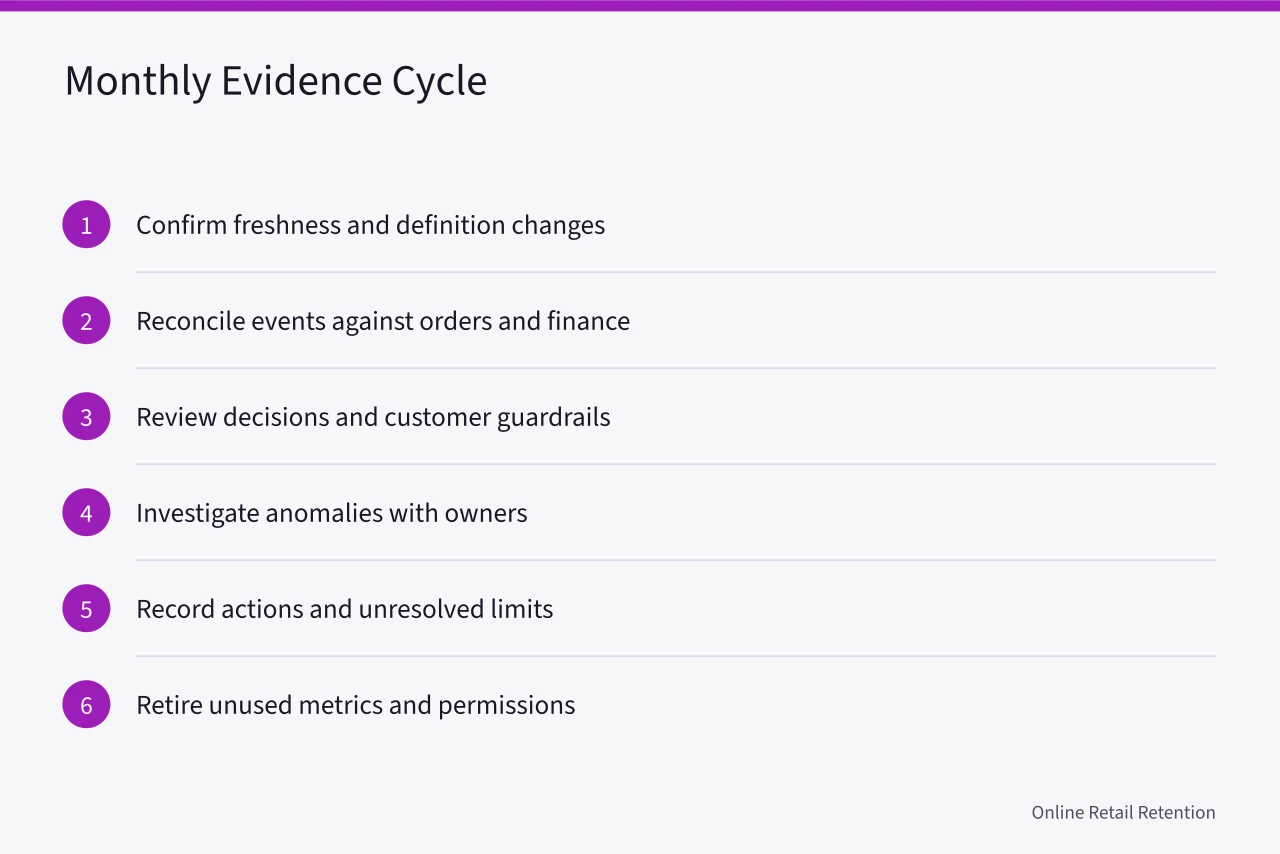
The monthly evidence cycle
- Confirm freshness, incidents and definition changes.
- Reconcile events against orders, payments, returns and finance.
- Review the primary decisions and the customer guardrails.
- Investigate anomalies with the product and operations owners.
- Record actions taken, interpretations rejected, limits unresolved.
- Retire unused metrics, tags, extracts and permissions.
Quarterly, rebuild one important result from source records. Trace the lineage, the formulas, the exclusions, the joins, the currency handling and the maturity rules. Ask a second qualified analyst to reproduce it. If the number moves, publish the correction with the affected period, the old interpretation and the decision it touched.
Worked example: three journeys, traced end to end
Acquisition to mature order. Start from eligible exposure and keep channel, campaign, creative, audience rule and landing experience attached. Preserve consent state and cost. Compare platform credit against your own transaction and finance records, then follow the customer through evaluation, cart, checkout, payment and acceptance.
Discovery to suitable selection. Review internal searches, filters, category paths and recommendations. Check fit tools, comparison content, stock status and variant changes. Join behaviour to wrong-item returns, exchange reasons, product questions and service contacts. A rising product-page rate can be bad news if customers reach the wrong item faster.
First order to repeat value. Define the eligible cohort from a mature first purchase. Follow replenishment, education, service and saved preferences, then loyalty benefits and later orders. Separate organic return from programme exposure with a real comparison, and include discounts, benefits, message costs and support in the economic view.
For each journey, sample individual records as well as totals. Check that timestamps follow the intended time zone and that currencies convert under a stated rule. Confirm product and campaign labels match their effective dates, and that merged or deleted identities behave as documented.
Review the awkward cases:
- Guest checkout
- Split shipment
- Partial refund
- Marketplace fulfilment
- Gift purchase
- Subscription pause
- Order entry by a service agent Aggregate agreement hides offsetting errors. A small record sample often shows that the right total came from the wrong customers.
Save the sample method and the correction threshold so the audit can be repeated next quarter.
Verify before you release
The GAO evaluation design guide sets out how evaluation questions, evidence needs and design choices fit together. It is written for federal programme evaluation. Use its discipline to check your method, not as proof that a marketing result is causal.
The W3C Privacy Principles statement gives designers shared vocabulary for privacy and warns against shifting privacy work onto individuals. Apply that to the data flow behind your analytics. It does not replace the law, your contracts, consent analysis or a review of the live configuration.
The GOV.UK technology selection guidance recommends choices that can change over time, preserve data control, address security risk and account for ownership cost. Those public-service rules make decent buying questions for a retail stack. They are not private-sector mandates or product endorsements.
Record what you tested: the data, the roles, the product versions, the exceptions, the approval date. Repeat the review after any material change to a source, model, access rule, contract or decision.
Common questions
The questions below are the ones that come up when a platform total and a finance total disagree.
What is ecommerce analytics?
It is the controlled use of customer, product, transaction, operational, research and financial evidence to improve commerce decisions. The control matters as much as the evidence: definitions, ownership and reconciliation are what make a number usable.
Which metric should a new store track first?
Start with mature accepted orders and net contribution, then add diagnostic measures tied to whatever decision is live. Leading signals tell you where behaviour changed; they should never be reported as equivalent to revenue.
Can platform revenue be treated as accounting revenue?
No. Reconcile platform events against orders, payments, refunds, tax, returns and your own accounting treatment. Attribution allocates credit under a model, and that model is not a ledger.
How often should definitions be reviewed?
On a fixed schedule. Also whenever the catalogue, checkout, identity or consent changes. Also whenever the vendor, order flow or business decision changes. A definition that has drifted silently is worse than no definition, because people still trust it.