Strategy
Shop the look modules: labels, returns and disclosure
Shop the look modules are affiliate rows: how the commission flow works, why resemblance tiles raise returns, and how to measure the channel before you renew.
What to take away
- Shop the look modules are affiliate rowsyou pay commission on sales after a click, and nothing on the clicks that do not convert.
- Most tiles are resemblance matches rather than the photographed piece, so returns from this traffic run above your site average.
- Disclosure is the publisher's duty, and your own claim wording sits under the same federal authority.
- Treat the row as a traffic and audience test, then move the winners into your own email and on-site merchandising.
Where the commission goes
A look module reads like a caption and works like a checkout lane. Each tile carries a tracking code, and the publisher is paid when a click becomes an order.
Creator rows sit beside your own social output, and this guide to ecommerce social media covers the overlap most teams miss.
| Party | Contributes | Earns |
|---|---|---|
| Publisher | Photo, page, audience | Commission per sale, sometimes a placement fee |
| Affiliate network | Tracking, reporting, payment | A cut of the commission |
| Retailer | Stock, fulfillment, returns | The sale, minus commission |
| Matching service | Software pairing photos with in-stock items | A fee or a share of commission |
| Lending house | The garment, on loan | Exposure only |
Note who is missing from the last column. The person in the photograph is not paid, and the lending house sees none of the revenue.
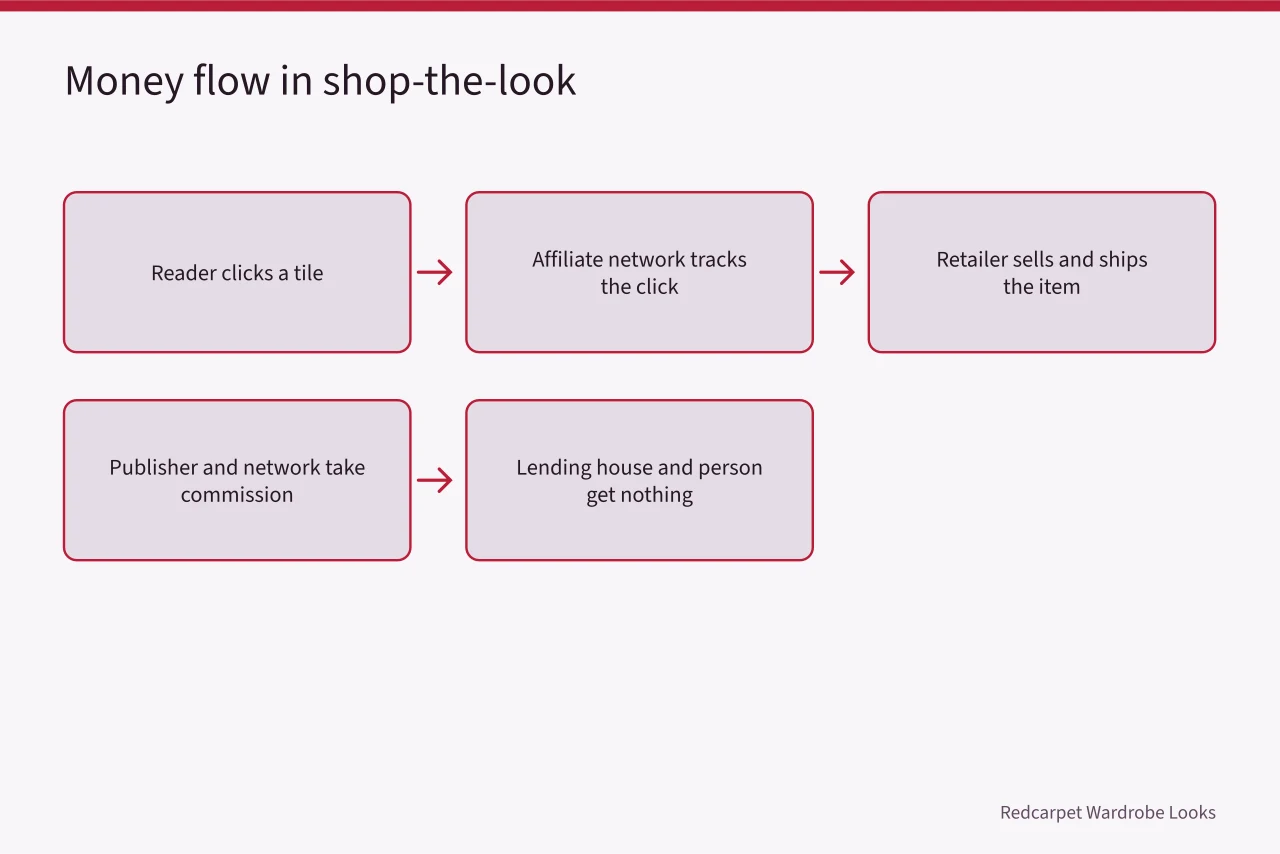
Illustrative arithmetic on a $120 order: a 20 percent commission leaves $96 before shipping. Free outbound delivery plus a 30 percent return rate can push the row below break-even.
Return shipping sits on your side of the ledger, and the publisher is paid either way.
A tile that converts once and returns twice is not a sale.
Those clicks also land on product pages that have to rank without paid help, which is the case made in this realistic take on ecommerce SEO.
What the tile labels commit you to
Tile wording is a contract in miniature. Five label styles recur, and each promises something different about the product behind it.
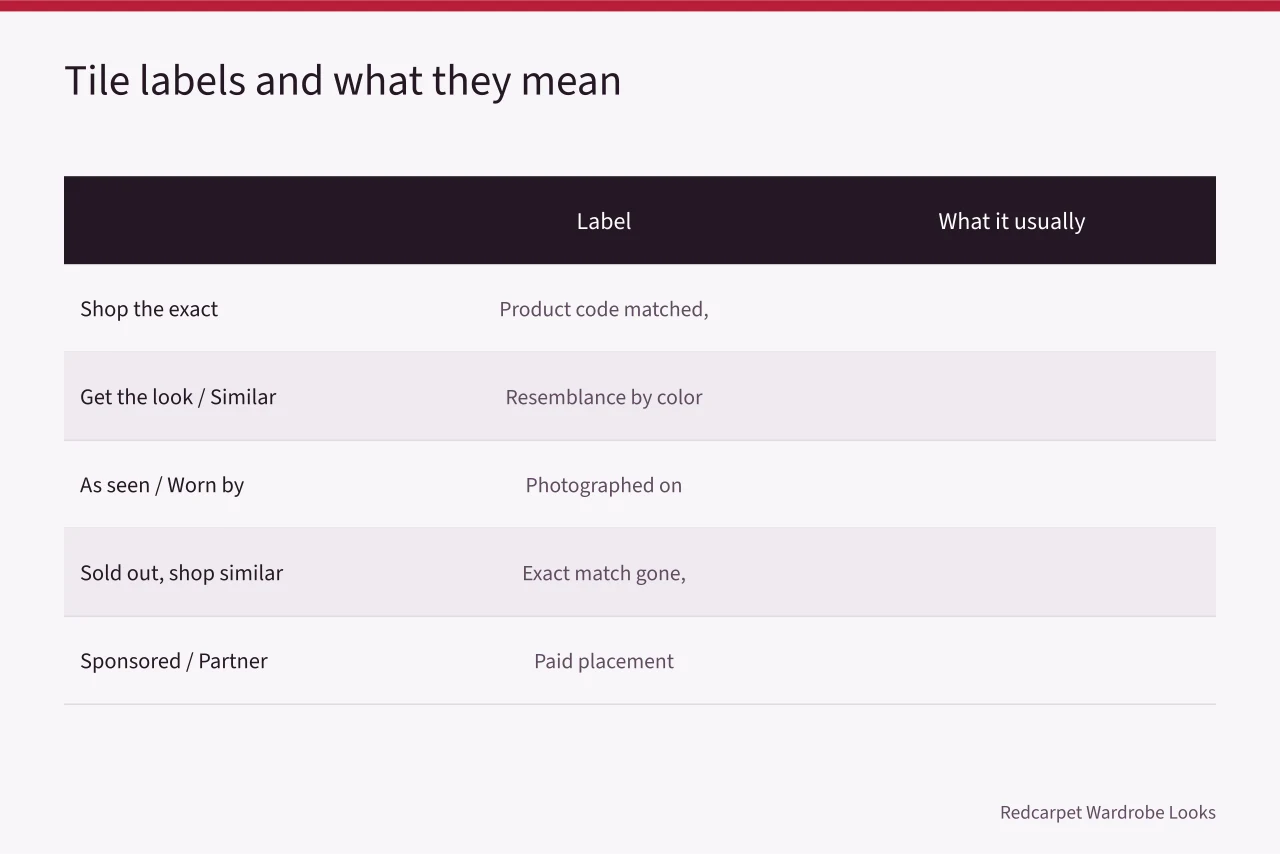
What it promises
- Exact match
- The same product or season
- Similar
- Shares one or more properties
- Inspired by
- A style direction, not a product
- Sponsored
- Paid placement, no resemblance claim
- Get the look
- The styling effect, not an item
What it costs you
- Exact match
- Low returns, narrow overlap
- Similar
- Higher returns, fit complaints
- Inspired by
- Loose attribution, brand confusion
- Sponsored
- Media cost, no editorial cover
- Get the look
- Broad intent, low specificity
The word similar does most of the work. It can mean a garment that shares a shape and a fabric, or one that shares a color and nothing else.
Nothing in the tile says which property matched. That gap shows up in your return rate when the price point is high.
If the styling effect is what converts, the content behind it belongs in your own calendar, which is the case for ecommerce content marketing.
Why the piece in the photo is not in your catalog
Sample garments arrive on loan, are altered to a single body, and go back to the house. They exist in one size, sometimes as a single piece.
Custom pieces exist once. Archive pieces are decades old. The row is matching a future product, a one-off, or a museum object.
Street photography is different. Clothes worn outdoors on an ordinary day are likelier to be in shops already, though the piece may still be a gift or a loan.
The response is simple. Claim the exact tiles you can fill, and label the near matches honestly.
Example: the jewelry tile
Jewelry is the worst category for this channel. Event pieces are high-value loans, and the tile beneath them usually shares a scale and nothing else.
A ring matched by resemblance to a press photo invites a return or a chargeback. Ask for the item identifier before you approve the tile.
Disclosure, claims and renewal terms
How you price, disclose and renew the channel is a strategy question, and this ecommerce marketing strategy piece works through the version that survives a bad quarter.
American law puts the disclosure duty on the publisher, and the FTC expects a commission line to be hard to miss. The rule that does the work here is the FTC's Endorsement Guides, formally 16 CFR Part 255. Your own claims run under the same authority, set out in FTC Act Section 5.
Cancellation deserves as much attention as the buy button. When a row sells a repeat delivery, the path out has to be as short as the path in.
Measuring the channel before you renew
- Pull the click-to-order rate by tile label. One blended figure hides the gap between an exact row and a similar one.
- Compare the return rate for similar tiles with your site average, and count the return shipping you absorb.
- Read the terms on the tiles that convert, because a workable return policy does more for repeat purchase than a discount code.
- Track 90-day repeat purchase by cohort.
Repeat behavior decides renewal, and this overview of customer retention sets out the definitions worth using. Cohorts only tell the truth when your own lifecycle messages are clean, which is the argument in this piece on ecommerce email marketing.
Common questions
Do the prices in a module stay current?
Not reliably. Prices are captured when the page is built, so check your own product page before you approve a tile.
Should a retailer refuse affiliate rows entirely?
No. It is a legitimate channel when it is disclosed and when near matches carry a clear label.
What is the module actually good for?
It is a testing surface. It shows which silhouettes, fabrics and colors draw clicks, and you carry those findings into your own merchandising.